Automated processes are at the heart of any large-scale food production business. These are integral to our product, allowing it to slot seamlessly into a wider operation.
This article was written by IGS’ Chief Engineer, Barry Anderson. Barry leads a team responsible for our product’s hardware, helping to ensure it remains cutting-edge and fit for purpose.
Automation – the use of technology to perform tasks or processes with minimal human intervention – forms the backbone of many manufacturing industries. When designing vertical farming technology and thinking about how it can integrate into a wider system, automated systems can be fundamental to operational success.
Regardless of the size of a site, automation can bring consistency of output, efficiencies in production, and safer (but also faster) workflows. At IGS, our approach is shaped by decades of engineering expertise, leaning on principles from other sectors and seeing how they can be applied to controlled environment growing. This can present some fairly unique challenges, but also the opportunity to rethink how systems, sensors, site design, and software can combine to reduce the need for human intervention.
Over the years, we’ve learnt how automation can enhance plant growth and ultimately how crops interact with our Growth Tower technology. We design our systems and processes in a way that prioritises uptime and allows for effective integration into large scale sites, so our customers can seamlessly manage complex workflows involving automation and equipment from other providers. Here’s how this all works in practice, along with an exploration of which emerging technologies we believe will play an influential role in the years to come.
Drawing parallels with traditional manufacturing principles
Many of the core principles in how we use automation can be traced back to traditional manufacturing. Process control, safety systems, and autonomous material handling all benefit from automated technologies in the automotive, oil and gas, and food and drink sectors. Vertical farming is no different.
Once a Growth Tray with Lights (GTL) is introduced at the entrance to a tower on a trolley, every step required for growing can be fully automated. We embed sensors to verify position, status, and safety across its journey, as well as to give a comprehensive overview of the Growth Tower’s environment to feed back to the software. This all comes together to provide live, actionable feedback to the end user, only directly involving them when necessary.
Light curtains, which sit at the entrance to a Tower, effectively work to lower any unnecessary risk by stopping the system when a human is present inside the tower. This mechanism is not unique to vertical farming, but does provide an example of automated safety management systems which we have adapted to a controlled environment.
Adapting sensor strategies for controlled environments
Sensors are an important component of how we can monitor and control the growing environment. These are commonly used across manufacturing, but require a different approach when working within a controlled growing environment.
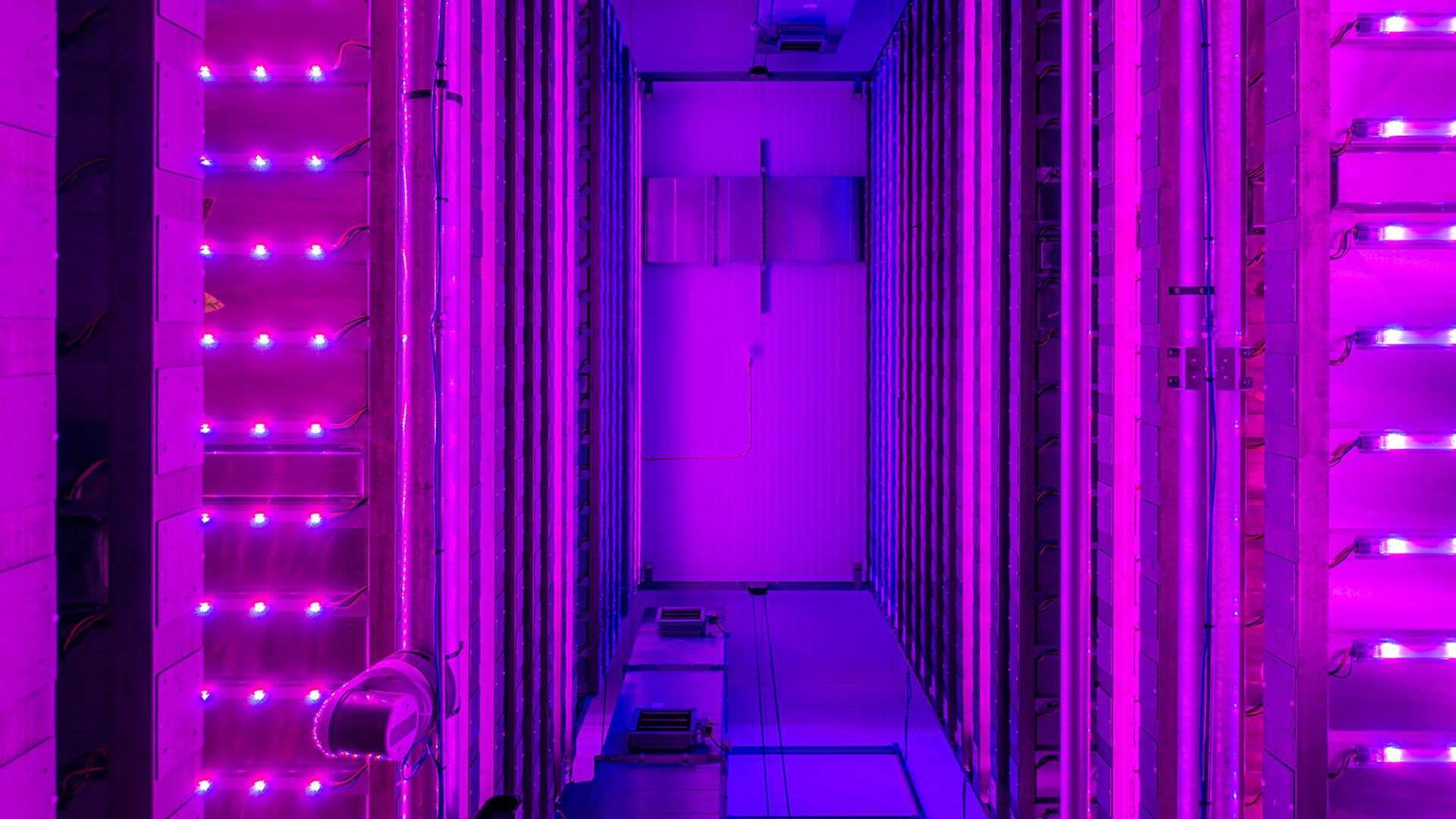
Our Growth Towers are large, vertical volumes. Using a single temperature sensor simply wouldn’t work to give an accurate gauge, but, on the flipside, overloading the system with too many would add complexity. Through testing, we’ve developed a balanced approach, using a small number of well-positioned sensors across the top, middle, and bottom of each tower. We’ve found this provides sufficient data to maintain environmental control, while also managing the unique nuances of a vertical farm, such as heat and its natural tendency to rise. Sensors give us the touchpoints we need to adjust airflow and extraction at different levels across the tower, using reliable and representative data to maintain a consistent temperature throughout.
Accelerated testing for predictable performance
For any manufactured product, it pays to have confidence in its durability before releasing it to the market. Automation has a clear part to play here, helping to identify when components may need maintenance in a way that draws parallels from other industries.
We use accelerated life testing when validating components. In practice, this works by calculating how many operational cycles the component is set to perform over several years, and putting in place a system to monitor what this looks like over the course of weeks or months. A good example of this would be the lifts that move our GTLs. These are stationary for most of the day, and their number of daily movements is fairly predictable. By replicating years of movement in a compressed timeframe, we can validate motors, gearboxes, and other structural components and get an estimate of maintenance requirements far quicker than waiting for real-world wear and tear.
This automated testing approach can also be seen in automotive and industrial engineering, where warranties are backed by similar tests as opposed to elapsed time. Simulation tools allow for stress and strain to be calculated long before components are manufactured, making for a more predictable and efficient design process.
Designing sites and systems around autonomous practices
Once a crop has been added to IGS Growth Towers, everything needed to ensure successful growth can be fully automated. Outside a tower, however, is where tweaks need to be made depending on the size and scale of the operation.
.jpg)
If a customer is operating with two or three towers, manual handling of trolleys is feasible. As sites scale to tens, or even hundreds of towers, this approach becomes impractical. Moving GTLs manually across such a large facility is not only labour intensive, but also a cause of general inefficiencies and operational risk. Clever use of automation can help to streamline this process.
Whilst we do not include robotics as part of our product, we do work closely with our customers to understand and support their automation needs. Doing this well includes appreciating the different dynamics an autonomous mobile robot (AMR) could encounter in its day-to-day tasks, such as moving around a facility whilst not disrupting wider operations.
Any AMR moving GTLs around needs to rely on rules, sensors, and predefined behaviours to safely move a four-metre-long tray through a facility. We’re essentially asking it to understand not only its own dimensions, but how these change depending on whether it is carrying a GTL or not. You then have to factor in movement direction, turning radius, and the physical space in which it is operating – this makes site design pivotal. We’ll work with planners and encourage them to design sites with automation in mind, looking at aspects such as corridor width and corner radii. If we focus on these from the outset, automation across a site is far more feasible and can benefit operators in a far greater way.
Where we see automation benefiting controlled environment growing
Developments in both robotics and sensors will have a significant impact on vertical farming. Humanoid robots have the potential to perform tasks that currently require a high level of human dexterity such as harvesting, transplanting, and delicate handling operations. Some robots can perform these tasks already, but from what we’ve observed, speed remains a limiting factor. To be truly viable, automation must match or exceed human output.
Sensors are another interesting component as technology continues to develop. These are becoming cheaper, smaller, and capable of handling a far higher data bandwidth than before. This allows them to collect and analyse data that might at first glance seem irrelevant, but later proves a valuable tool. When working with enhanced data capacity, we’re able to underpin improvements in everything from automation, general maintenance, and system operation.
Technological advancements mean we are now seeing sensors capable of delivering real-time feedback to the end user. We already use sensors to send data used to help directly control the growing environment, but as these get more advanced, the scope for automation will continue to expand.
What this means for operators
We’re already working with multiple automated systems in vertical farming. These help operators to work smarter and more efficiently, reducing the number of people who need to make decisions central to everyday operations by automating them.
By applying proven principles already prevalent in manufacturing industries, we can use automation to reap the benefits of controlled environment growing while embracing new technologies. This can help our industry to grow beyond its current form, becoming the bedrock on which reliable, commercially viable operations are built.
For more expert insight across a wide range of topics within agritech, explore the full range of articles on the IGS blog.