

A productised, reliable, and efficiency-led approach to vertical farming that puts positive unit economics first
This article was guest written by Niels Kortstee, Head of Product & Marketing at Intelligent Growth Solutions. Niels is responsible for product development and innovation, alongside identifying and pursuing new market opportunities for vertical farming technology.
For years, yield has dominated the conversation in vertical farming, and for good reason. A higher yield per square metre typically means more revenue. However, high yield alone does not make an operation commercially viable.
Indoor growing is no different to any other sector: the businesses that survive and thrive are those built on disciplined product principles that protect unit economics, reduce risk, and deliver consistent performance at scale. These principles form the foundation of our product strategy, and are the reason customers and investors trust our technology to deliver repeatable, bankable results. Yield matters, but it is only part of the equation.
Yield will always be a key driver of farm revenue. Doubling the yield per square metre does, at least in theory, double the potential revenue generated from that area. But it’s important not to focus on yield alone.
The ultimate indicator of whether a project is commercially viable is the number of years taken for the investment in technology to be repaid through produce sales: the payback period. Beneath that payback period sit five main drivers:
- yield – the quantity of crop that can be produced on a given cultivation area
- economic value of produce – the price the produce can be sold for
- initial investment – the cost of setting up the cultivation area
- labour – the manual labour needed to produce a given output, considered alongside the cost of employment
- energy – the cost of each kWh of electricity and the efficiency of its usage
We build our technology with each of these factors in mind, designing carefully to strengthen each core driver and create a solid foundation for profitable vertical farming operations.
Three traits that make a commercially viable vertical farm
Productised and globally repeatable
Many vertical farming systems on the market today are marketed as adaptable to a specific project, location, or facility. However, this bespoke-design process results in variable performance from one deployment to the next. This creates a significant obstacle for customers and investors, as the technology is not fundamentally repeatable, making the approach risky, expensive, and hard to scale
We take the opposite approach, designing our vertical farming technology to be a productised, modular, standardised platform. This ensures repeatable yields and consistent performance across every deployment, anywhere around the world. A repeatable product means that customers, investors, and partners know what to expect from one project to the next, increasing commercial confidence.
Energy efficient
Energy is typically the largest operating expense in vertical farming. This was brought into sharp focus following the war in Ukraine in 2022, when global energy prices rose to unprecedented levels. As a result, scrutiny on energy consumption intensified. The development of viable business models for vertical farming projects requires greater care be taken over planning and modelling, with particular consideration of areas such as energy distribution, efficiency, and material selection.
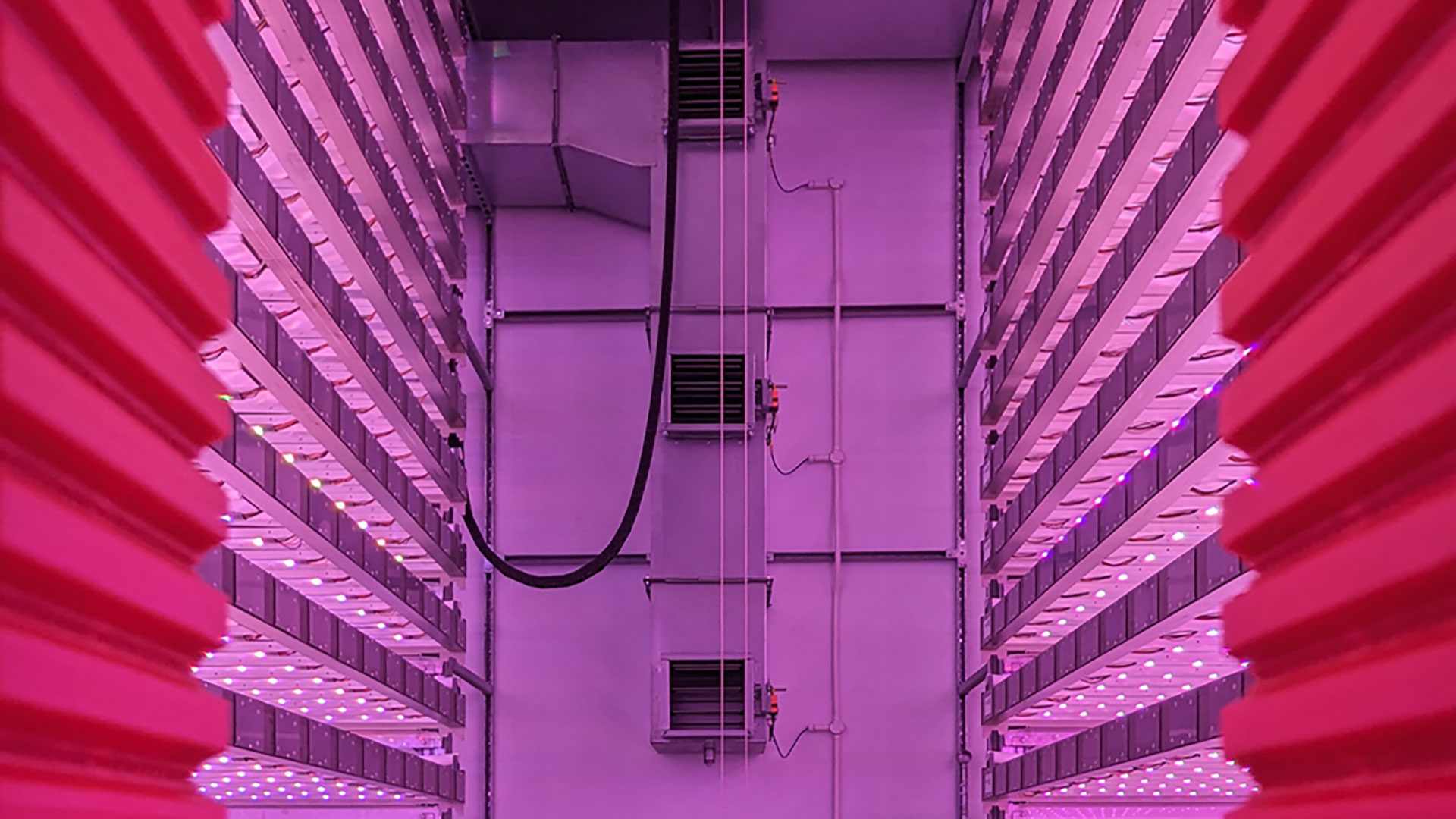
From a product perspective, this must be approached strategically. Before implementing any change – whether a new recipe, LED strip, or subsystem redesign – we question whether it improves energy efficiency. Efficiency upgrades are rolled out across our existing customer base, ensuring they benefit from continuous improvement, not one-off, bespoke innovations.
Partner-enabled, open architecture
Vertical farming cannot operate in isolation. To run a successful operation, the product must integrate effectively with industry standard technologies and workflows. Our strategy is built around collaboration with specialist partners, rather than a closed, proprietary approach. This works best when systems are built on open, modular principles, enabling scalability and seamless integration with third-party platforms, allowing our customers to combine best‑in‑class technologies.
Learning from past failures
It would be remiss not to acknowledge past high-profile industry failures, however these examples reflect specific approaches rather than the concept itself. Several key lessons can be drawn:
- establish what good looks like from the start – ensure you clearly define and understand business goals, specifically what you want and need to achieve
- prioritise unit economics above all else – this means keeping a firm grasp on the costs of what you grow, where you grow it, how you grow it, and who you plan on selling it to
- select technology that is fit for purpose – technology needs to be productised, efficient, and able to be scaled repeatably
Changing the conversation
The conversation in vertical farming must shift from simply “what can be grown?” to “what can be grown sustainably and profitably?”.
.jpg)
We use our Grower Model to help customers evaluate commercial viability before a project begins. It is built on multiple factors, including already proven crop recipes, and capital and operational expenditure, such as labour and energy, market prices, and other crop-related economics. It reframes the discussion around the metric that matters: can this farm deliver an acceptable payback period? That is the real measure of success.
This metric captures all underlying drivers, including yield, labour, energy and initial investment, within one comparable measure. It enables customers to evaluate the true value of the technology, the viability of their projects, and the conditions required for long-term success. We have long advocated for greater collaboration and transparency within the industry. By concentrating on the right metrics, this can be achieved while laying the groundwork for sector-wide prosperity.
Redefining success in vertical farming
The future of vertical farming won’t be defined by who can grow the most. It will be defined by who can grow profitably, efficiently, reliably, at scale and repeatedly, year after year.
This is exactly what our product principles enable and why they matter. Vertical farming doesn’t need reinvention. The next decade will belong to those who embrace productisation, measurable performance, collaboration and bankability. That is the direction we’re committed to leading.
If you enjoyed this blog, visit our resource hub for more articles on topics such as automation, biosecurity, and software development, alongside on-demand webinars and guides covering key areas of successful vertical farming.